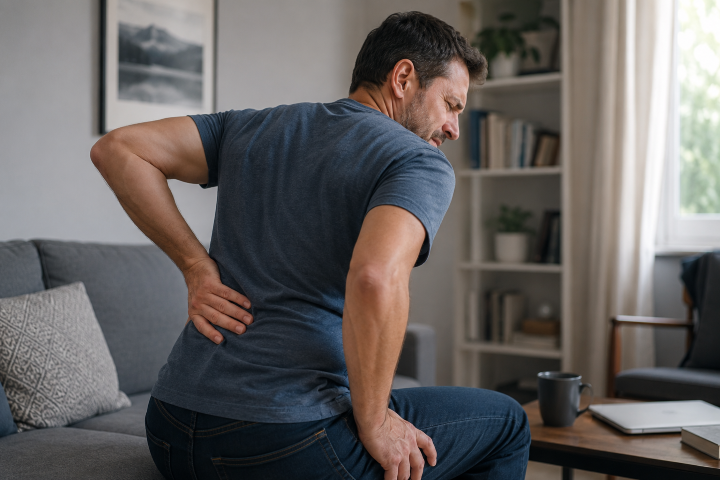
A $2 tennis ball, ten minutes, and four weeks of consistency. In controlled research, that combination reduced chronic pain — in a majority of the controlled trials that tested it.
Ten minutes a night with your own hands, a tennis ball, or a $20 foam roller reduced chronic pain in a majority of controlled studies. Across those trials, home self-massage — often paired with light exercise — produced significant, measurable pain relief on its own. Most people have never heard that, and there’s a simple reason: nobody makes money telling you to use your own hands.
What the Research Actually Says
A published systematic review analyzed 17 clinical studies on self-massage for chronic musculoskeletal pain. Of the 11 that tested self-massage as a standalone intervention, 7 showed significant, measurable improvement — a 63.6% success rate under controlled conditions.
The finding worth sitting with: patients with myofascial pain dysfunction syndrome (MPDS — chronic pain from tight, knotted muscle tissue) who combined self-massage with home exercise reduced pain more than patients receiving professional physical therapy alone. People working on themselves at home outperformed people outsourcing the whole job.
The mechanism is plain physiology. Sustained pressure on muscle tissue stimulates pressure receptors, which signal the nervous system to lower cortisol (the stress hormone) and release endorphins (your built-in painkillers). Your body already has this response wired in.
The honest tradeoff: 63.6% success means roughly one in three participants saw no significant improvement. This works for most people who stick with it. It will not work for everyone.
Home self-massage produced measurable pain relief on its own in a controlled study. Nobody has a financial incentive to put that on a billboard.
Why You’re Probably Quitting Before It Works
The most common treatment duration across the studies that showed significant outcomes was four weeks of consistent practice. Most people try it twice, feel modest relief, get busy, and stop — which means they quit inside the window where the effect is still building.
The physiological changes — reduced muscle tension, lower baseline cortisol, better tissue mobility — accumulate. Think of it as maintenance rather than emergency repair. If you only reach for the foam roller during acute pain, you’re already behind.
The habit sticks when you attach it to something you already do. Ten minutes, three nights a week, post-shower or pre-sleep or after a workout. Pick one anchor and keep it boring.
Do the Math on Your Pain Spending
A foam roller costs $20. A tennis ball costs under $2. A trigger point tool runs $15–$40. All one-time purchases that last years.
A single physical therapy session runs $75–$150. Professional massage is $80–$120 an hour, so monthly sessions for chronic pain put you at $960–$1,440 a year. Chronic musculoskeletal pain also drives a meaningful share of household OTC painkiller spending, and pills suppress the signal while the restricted tissue underneath stays restricted.
Self-massage will not replace professional care for acute or complex conditions. It reduces how often you need that care, and that gap is where the savings live.
When Self-Massage Is the Wrong Call
Never use self-massage to mask pain that needs a diagnosis. Pain that is new, sharp, radiating down a limb, or paired with numbness, tingling, or fever needs a doctor first.
Inflammation and muscle soreness are different problems. If an area is hot, visibly swollen, or acutely painful, sustained pressure makes it worse. Hard stops: active blood clots, osteoporosis, open wounds, skin infections, recent surgery, and pregnancy without medical clearance.
The Body-Map Protocol
Head and scalp
Fingertip circles across the scalp with moderate pressure. For tension headaches, hold firm pressure at the temples and the base of the skull for 30–60 seconds. No tools needed.
Neck and shoulders
Cross your arm to the opposite shoulder and work fingertip pressure along the muscle belly, staying off the spine, up to five minutes per side. A tennis ball pinned against a wall gives you the same pressure without tiring your arms.
Upper and lower back
Foam roller along the paraspinals — the muscle columns on either side of the spine, never the vertebrae themselves. This is the technique from the MPDS study, and pairing manual work with movement consistently outperforms either alone.
Hands and wrists
Fifteen minutes before bed: thumb circles across the palm, gentle traction on each finger, sustained pressure on the wrist flexors. Studied for arthritis and repetitive stress. Do it during a show and it costs you nothing.
Feet and plantar fascia
Roll a tennis ball or a frozen water bottle under the foot, holding pressure at the heel and arch — first thing in the morning, before your first steps. High-leverage for plantar fasciitis.
Tool guide: hands for precision, tennis balls for back, glutes, and feet, foam rollers for large muscle groups, trigger point tools for small deep spots that fatigue your hands.
Alongside Professional Care, Not Instead of It
The MPDS study didn’t make physical therapy useless. It showed that patients who did consistent work between sessions beat patients who stayed passive. Your therapist still owns assessment, diagnosis, technique correction, and acute flares; self-massage covers the daily maintenance a weekly appointment can’t.
Tell your therapist about your routine. They can correct your technique and fold it into the plan, and the result over time is fewer appointments because you’re actually improving between them.
Pick one pain site from the map above and run it for four weeks — the research threshold — before judging whether it works. Ten minutes and a tool cheaper than a single copay. More practical health strategies live in our Health & Nutrition section when you’re ready for the next one.
This is not medical advice. The information on this page is for general education and reflects publicly available research as of the date noted on the article — it is not a substitute for a diagnosis, treatment plan, or guidance from your own doctor or a qualified healthcare provider. Individual health circumstances vary widely; what applies to the research or examples discussed here may not apply to you. Talk to a healthcare professional before making changes to medication, diet, exercise, or supplement use, especially if you have an existing condition or take prescription medication.